What actually determines
how much you receive.
Every case below started with a low offer.
Here's what changed it — and whether the same applies to yours.
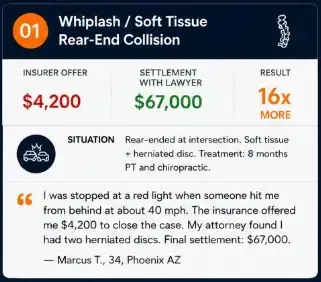
What drove the value:
Objective imaging evidence — MRI confirmed two herniated discs at C5-6 and L4-5. Soft tissue injuries without imaging are routinely minimized. The scan changed everything.
Consistent treatment over 8 months — Uninterrupted PT and chiropractic care documented a clear recovery timeline. No gaps the insurance company could point to as "proof of recovery."
Documented impact on daily function — Pain journal entries and employer letter confirmed inability to perform job duties for 6 weeks, supporting lost wage claim.
Initial offer timing — Offer came within 72 hours of the accident, before any diagnosis existed. Classic tactic to close the case before the full picture emerged.
Attorney identified pre-existing condition risk — Insurance attempted to attribute disc issues to age-related degeneration. Medical expert testimony established the accident as direct cause.
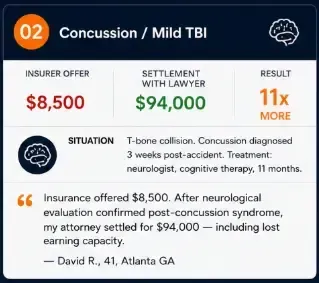
What drove the value:
Delayed diagnosis documentation — Symptoms appeared 3 weeks post-accident. Attorney secured medical records establishing the neurological timeline — critical because insurance argued no immediate injury.
Neuropsychological evaluation — Formal cognitive testing confirmed post-concussion syndrome. Without this, the claim would have been treated as a minor headache case.
Loss of earning capacity — Client's job required sustained concentration. Employer documented measurable performance decline over 11 months, supporting future earning loss beyond just missed days.
No visible injury challenge overcome — Concussions leave no external mark. Attorney built the case entirely on medical documentation, expert testimony, and the pain journal started week one.
Treatment continuity — 11 months of documented neurologist visits and cognitive therapy established chronicity. Insurance cannot argue "you recovered" when the treatment record says otherwise.
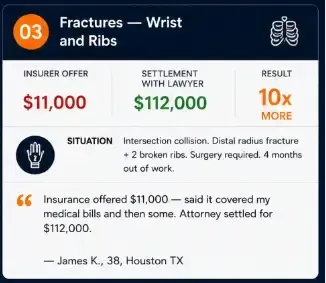
What drove the value:
Surgical documentation — Distal radius fracture required open reduction internal fixation surgery. Surgery transforms a fracture claim into an objective, undeniable injury with documented medical costs.
Occupation-specific impact — Construction work requires full grip strength. Attorney documented that partial grip loss permanently affects earning capacity in client's specific trade — not just general disability.
4 months lost wages calculated precisely — Pay stubs, union wage records, and employer letter established exact income loss. Insurance's offer didn't include a single dollar of lost wages.
Future medical needs established — Orthopedic specialist documented likely need for hardware removal surgery and ongoing PT. Future costs must be calculated before settlement — not after.
Insurance offer framing exposed — "$11,000 covers your medical bills and then some" was demonstrably false once attorney itemized actual bills ($34,000), lost wages ($52,000), and pain and suffering separately.
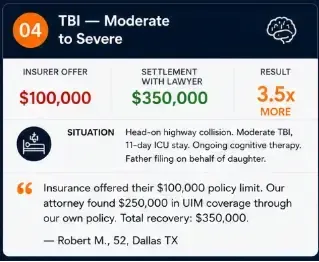
What drove the value:
Policy limits vs. UIM discovery — At-fault driver's policy maxed at $100,000. Attorney identified $250,000 in Underinsured Motorist coverage on the family's own policy — coverage they didn't know applied. This alone tripled the recovery.
11-day ICU documentation — Length of hospitalization established severity. Every ICU day is documented medical cost plus documented pain and suffering multiplier.
Ongoing cognitive therapy established chronicity — TBI symptoms continuing at time of settlement supported future medical cost claim. Settlement included projected 3 years of continued therapy.
Father filing on behalf of daughter — Attorney navigated legal standing for family member to act. Without this, the claim could not have been filed while victim was incapacitated.
Independent neurological expert — Insurance-hired doctor claimed "full recovery likely." Plaintiff's neurologist documented measurable cognitive deficits. Expert testimony was the deciding factor in negotiation.
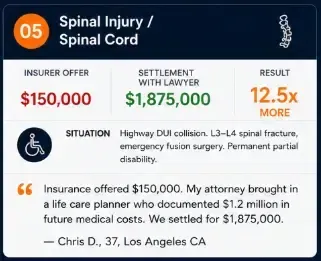
What drove the value:
Life care plan documentation — Certified life care planner produced a formal report projecting $1.2 million in future medical costs — surgeries, PT, pain management, adaptive equipment over client's lifetime. This single document anchored the negotiation.
DUI at-fault driver — Criminal conviction of at-fault driver established clear liability with no comparative fault argument available to insurance. Also opened potential for punitive damages which significantly increased settlement pressure.
Permanent partial disability rating — Occupational medicine specialist assigned formal disability rating. At 37 years old, loss of earning capacity calculation extended over 25+ working years.
Emergency fusion surgery costs — L3-L4 spinal fusion surgical costs, hospitalization, and rehabilitation documented at over $280,000 in past medical expenses alone — well beyond the initial offer.
Insurance bad faith exposure — Initial $150,000 offer made while life care plan evidence was already in attorney's possession. Attorney's formal documentation of insurer's awareness created additional settlement leverage.
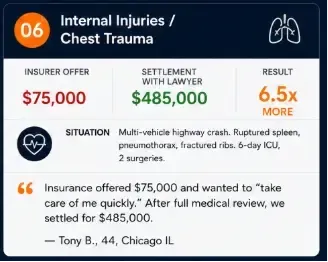
What drove the value:
Direct contact attempt blocked — Insurance called client directly while still in recovery, attempting to settle before attorney involvement. Attorney intervened, preserving all negotiating leverage. The $75,000 offer was made to a medicated patient 4 days post-surgery.
Splenectomy future complications documented — Removal of spleen creates permanent immune compromise requiring lifelong medical monitoring. Infectious disease specialist documented lifetime medical cost implications not visible in initial bills.
Two surgeries = two sets of documented costs — Each surgical event carries its own hospitalization, anesthesia, surgical fees, and recovery documentation. Both included in medical special damages.
6-day ICU stay established severity — ICU billing alone exceeded $180,000. Established that insurance offer of $75,000 didn't cover even half of documented past medical costs — making lowball nature of offer legally demonstrable.
Multi-vehicle crash liability established — With multiple vehicles involved, attorney investigated all parties' insurance coverage and established primary liability. Additional coverage sources identified beyond the single at-fault driver's policy.

You've seen what changes the outcome.
One call tells you if it applies to your case.
Get a direct answer.
Not a sales pitch.
One call with someone who's handled
a thousand cases like yours.
No fees unless you win. 100% free consultation.

How it works:
Step 1: Fill out the short form
Step 2: A licensed Arizona attorney reviews your situation personally —not an assistant or a bot.
Step 3: An attorney will call you back within 2 hours — with real answers, not a callback from a paralegal. Monday-Friday, 8am-6pm

My Crash Benefit exists to make sure accident victims have the information they deserve — before making any decisions. We connect accident victims with trusted and licensed attorneys. This site does not provide legal advice. Content is for informational purposes only.
© 2026 MyCrashBenefit. All rights reserved.